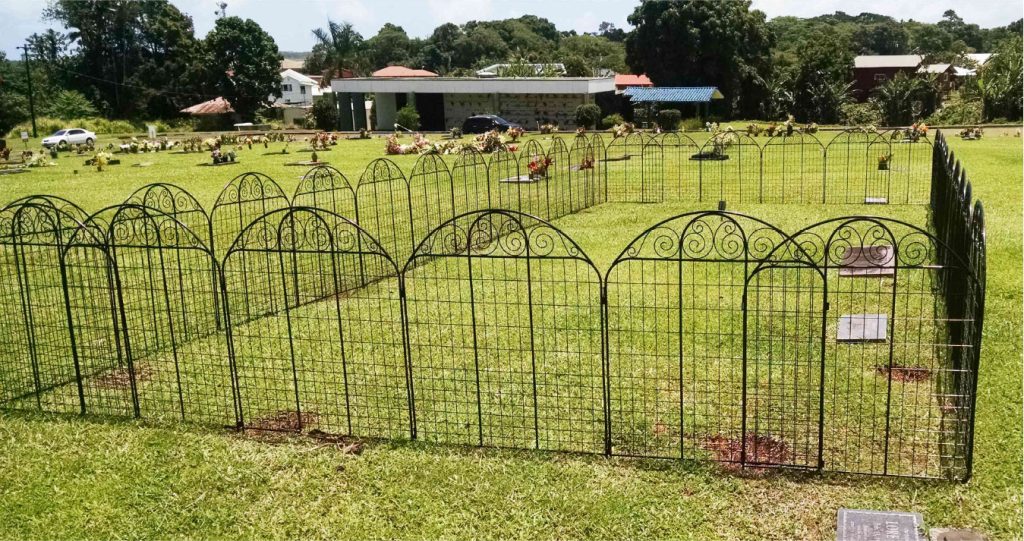
Beit HaShamayim is the name of the Big Island’s Jewish Cemetery. Located within Homelani Memorial Park in Hilo on the eastern side of Hawaii Island, Beit HaShamayim is the only Jewish cemetery on the island. It is open to all Jewish families and persons in need, whether Jewish by birth, choice or family relationship.
Beit HaShamayim, in Hebrew, and Homelani, in Hawaiian, both mean “Heavenly Home.”
Just as synagogues preserve Jewish continuity in life, so do Jewish cemeteries preserve Jewish continuity after life has ended. Congregation Kona Beth Shalom (KBS) has purchased the plots that comprise Beit HaShamayim with the intention of reselling the plots in advance or as they are needed at the average of our original cost.
If burial in Beit HaShamayim is requested by you or your loved one:
In Judaism we believe that all individuals have innate dignity, a spark of the divine. We are all said to be created in God’s image. Death does not remove this holiness. Jewish burial rituals emphasize that all people enter the world as equals and leave the world as equals as well. This is the reason Kona Beth Shalom strongly recommends that the casket (aron) you choose be simple and plain (the traditional pine box constructed without nails, using wooden pegs). You will need to specify your choice with your mortuary. Other kinds of caskets are also permitted in Beit HaShamayim.
KBS offers the services of the Chevra Kadisha to prepare the deceased for burial, including tahara. Just as a newborn is washed and dressed, so too, the deceased is respectfully washed and dressed in preparation for leaving the physical world. Because we are holy beings, this spiritual work helps to midwife the soul on its journey from this world to the next with dignity and respect. Performing the taharah ritual is the work of the Chevra Kadisha, the Sacred Society. This ritual purification involves a gentle pouring of water over the body and the recitation of special blessings, prayers and readings selected from Torah, Prophets and the Song of Songs. The deceased is dressed in tachrichim (simple white burial garments) and placed in the aron (casket/plain pine box). As a final act of respect, the Chevra Kadisha asks for forgiveness from the deceased if there were any imperfections in their process and offers prayers for the soul’s eternal peace. The aron is then closed.
The highest act of gemilut chesed (deeds of loving-kindness) is that which is done for the dead, for there can never be any thought of repayment. -Tanhuma Vayehi. 107A
When the gravesite is purchased, it is the right to use the land, not the actual land that is purchased. Thus there is no deed to the land.
The advance purchase of a burial plot does not guarantee that a specific location in the KBS Cemetery (Beit HaShamayim) is reserved. The location of the reserved plot may change if the passage of time has led to other burials using other sites. All efforts will be made to assure that pairs or groups of plots purchased to be contiguous will remain so.
KBS has been acquiring the plots within the Beit HaShamayim mechitza from Homelani Memorial park since our Jewish cemetery was first established. We have finally obtained all those plots for KBS usage with the intention of keeping costs as low as possible for KBS members. Qualified individuals who have been KBS members for a year or more may now purchase individual plots, the price being the average price paid by KBS over the years. That amount is $4,323.
For all others qualified for burial in the KBS Cemetery but who have not been members, the price will be equivalent to the current price of other plots in Homelani Memorial Park. As of mid-August 2025, that amount was $8,900 per plot. Homelani raises their charges regularly.
Any owner of an unused plot in Beit HaShamayim who is leaving Hawaii permanently and wishes to relinquish ownership may donate the plot back to KBS to be used for charitable purpose, or may request repurchase of the unused plot from KBS at their original purchase price.
There are additional charges for funeral services and supplies from Homelani Cemetery as well as from the mortuary you choose. These include purchase of the casket, purchase of the burial vault, opening and closing the grave, purchase of the grave marker, etc. You are asked to place a deposit of $600 for the grave marker at the time that you purchase the plot itself. Please contact your mortuary and Homelani for their details. All mortuaries and Homelani offer discounts for financial arrangements made in advance.
You may call us with any questions.
Beit HaShamayim Committee:
Dr. Barry Blum
(808) 987-7417
KBS Treasurer Una Greenaway
(808) 217-9418
Homelani Memorial Park:
388 Ponahawai Street, Hilo
(808) 961-6051
Big Island Mortuaries:
Dodo Mortuary
Kona: (808) 322-9592;
Hilo, (808) 935-5751
Ballard Family Mortuary
Kona: (808) 329-5137;
Hilo: (808) 935-8445
