
Long before there was a synagogue on Hawai`i Island, there was Joseph Lazarus. He is widely regarded as the first known Jewish resident of the Kona district and among the earliest Jewish settlers anywhere on this island. 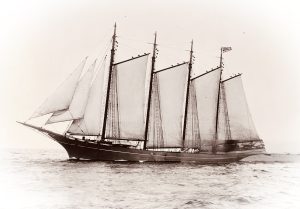 Born in Liverpool, England in 1830, he came to Hawai`i in the mid-19th century, and was a merchant and businessman at a time when Kona was a remote agricultural district, where the only reliable links to the wider world were the coastal schooners: vessels that nosed into rocky landings to take on coffee and hides, and to leave behind bolts of cloth, hardware, and news from Honolulu. A Jewish trader in such a place was a rarity, and Lazarus made himself a fixture of it.
He also became a landholder, and not in a small way.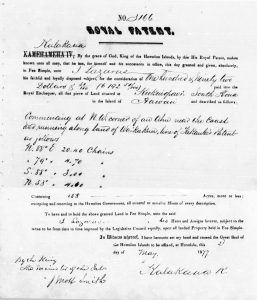 On May 5, 1877, King David Kalākaua signed Royal Patent Grant 3166, conveying to J. Lazarus 158 acres in fee simple at Kukuiopa`e in South Kona, between Ho’okena and Miloli`i. The patent, countersigned by Minister of the Interior J. Mott Smith, was recorded in the Hawaiian Kingdom’s land books in both Hawaiian and English, under the heading Palapala Sila Nui – the Great Seal Document. Records show Lazarus also held property on O`ahu and in Hōnaunau, that he later conveyed to the Bishop estate.
He married a Native Hawaiian woman of ali`i lineage named Kau`imakaole, joining his story permanently to the islands. They had five children, the eldest being Alexander, who is said to have kept a store at Keauhou and to have held land at Kaawanui. He also received two parcels of his own, in Hoʻokena, by grant in 1890.
The parents’ marriage did not last. After several attempts at divorce made their way through the courts, Joseph and Kau`imakaole were legally separated on November 30, 1893. Joseph died four years later, at age 67. His estate produced one final chapter of litigation: Kau`imakaole and her son Alexander went to court over title to the family’s Oahu property, and Alexander prevailed. Because the land was held in trust rather than owned outright by Joseph at his death, Kau`imakaole had no dower rights in it – a technical ruling with a lasting consequence for the family.
The next generation carried the story somewhere nobody could have predicted. 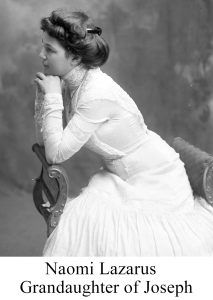 In 1897, Joseph’s granddaughter, Naomi Miriam K. Lazarus, married William Lai Hip, Sun Yat-sen’s representative in Hilo. Sun was educated in Honolulu, where he founded his first revolutionary society, the “Revive China Society,” in 1894, and the movement drew heavily on the Chinese communities of the islands. So a Liverpool Jew’s Hawaiian granddaughter married into the movement that would bring down the Qing dynasty.
What Joseph Lazarus left behind was a lineage and a number. His descendants carried the Lazarus name through the 20th century in Hawai`i: Eleazer Kukapuloa Lazarus Sr., 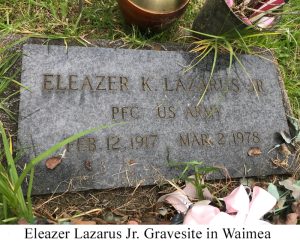 Eleazar Lazarus Jr. (1917-1978), Madeline Honipua Lazarus (1918-2017), Cecelia Kaui Lazarus (1920-1974), Wesley Kamaka Lazarus (1922-2005), and Aileen Kuulei Lazarus (1925-2003). And the legacy endures. In 2007, a Hawai`i County Planning Commission decision described a parcel in South Kona as a “portion of Grant 3166” – the same acres King Kalākaua signed away to a Jewish merchant 130 years before.
A Jewish trader’s story and a Hawaiian ali`i family’s story became one and the same, which is, in the end, the most Big Island ending imaginable.